

What are the benefits of modular construction?
Modular construction is transforming how we think about building. It’s a smarter way to build, with prefabricated building modules that are manufactured off-site in controlled factory environments, then transported and assembled quickly on-site.
What once took 12-18 months with traditional construction can now be accomplished in just weeks, without compromising on quality or functionality.
The construction industry is experiencing a fundamental shift in priorities.
Today’s organisations need solutions that deliver speed when time is critical, flexibility when needs change, sustainability to meet environmental goals, and exceptional value for money.
That’s where Neptunus can support your project’s needs with temporary and semi-permanent modular building solutions with nearly 90 years of experience. In this article, let us explore the full spectrum of modular construction benefits, showcase sector-specific applications, highlight our Evolution and Flexolution systems, and share case studies that demonstrate exactly how these advantages translate into practical solutions for organisations like yours.
Importance of Modular Construction
Traditional construction has served us well for centuries, but it’s increasingly misaligned with modern business realities.
Conventional building projects typically take months to years, create disruptive noise and dust, require substantial upfront investment with limited flexibility once complete, and often face planning permission hurdles that further extend timelines.
Modern challenges demand modern solutions. Today’s organisations need infrastructure that responds quickly to changing circumstances.
Suppose it’s a school discovering in July that September enrollment will exceed capacity, or a supermarket suffering fire damage that threatens customer relationships. In that case, modular construction can transform these challenges into manageable solutions.
The relevance of modular construction has never been greater. Demand is surging across education, retail, sports and logistics sectors for fast, safe, and sustainable building solutions.
Benefits of Modular Construction
Modular construction represents a conventional solution that’s not just fast, but also sustainable, flexible, and genuinely user-friendly.
Here are some of the comprehensive benefits that make modular building solutions the smart choice for modern organisations.
1. Speed of Set-Up
Speed is one of the most visible advantages of the Neptunus building system. While traditional construction projects move slowly through lengthy planning and building phases, our temporary buildings can be operational in a fraction of the time.
This speed is achieved through our modular building system. With a wide range of high-quality components available from our own inventory, we can start construction almost immediately once a project is approved. Site preparation and assembly can take place in parallel, significantly shortening delivery times.
Our Flexolution and Evolution buildings can be completed within weeks. The Evolution structure benefits from an innovative engineering technique that allows the roof to be assembled safely at ground level before being hydraulically lifted into position.
Real-world results show the impact of this approach. The McLaren showroom project was completed in just five days, creating a 216 m² premium retail space with branded interiors and finishes that reflected the high standards of one of the world’s most prestigious automotive brands. Similarly, our storage hall at the Port of Antwerp was operational within only three weeks, with the full interior fit-out completed shortly after.

2. Efficiency
At Neptunus, efficiency is built into every stage of our process. Our temporary buildings are designed for rapid on-site assembly using precision-engineered, reusable components manufactured under controlled conditions. This approach eliminates weather-related delays, minimises material waste, and ensures a consistently high standard of quality.
Efficiency also means minimal disruption. Unlike traditional construction, which can cause months of noise, dust and restricted access, our systems allow for fast installation and dismantling with limited impact on daily activities.
For example, our temporary sports halls can be erected quickly between sporting seasons, ensuring continuity for athletes, schools and communities without compromising on quality or performance.
3. Flexibility and Customisability
One common misconception about temporary modular structures is that they’re somehow limited or basic. Nothing could be further from the truth.
Our flexible modular buildings can be adapted to virtually any specific need
- School buildings with integrated technology
- Gymnasiums with specialised flooring
- Supermarkets with full refrigeration systems
- Restaurants with commercial kitchens.
The possibilities within our buildings are extensive. Options include glass facades that flood spaces with natural light, sophisticated climate control systems, acoustic insulation for optimal sound environments, and mezzanine floors that effectively double usable space.
Our TU Delft modular education building perfectly demonstrates this flexibility. The university required additional lecture space without permanent expansion, and our Flexolution system delivered a 2,115m² facility featuring four lecture halls and student areas.
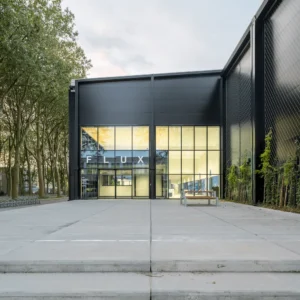
Designed with advanced acoustics, integrated technology, and high-quality finishes, the building provides a modern learning environment that blends seamlessly with the university’s permanent campus infrastructure.
4. Scalability
Perhaps one of the most strategic advantages of modular building solutions is scalability. Unlike permanent buildings that lock you into fixed configurations, our Evolution and Flexolution systems are built on modular “bay” increments that allow easy expansion, contraction, or complete relocation as needs evolve.
This scalability is invaluable for organisations facing growth, seasonal fluctuations, or changing requirements.
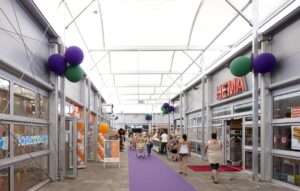
Our Temporary Mall project in the Netherlands demonstrates scalability at its finest, a complete 9,000m² retail centre erected in just 4 months to house 30 displaced stores while permanent reconstruction proceeded.
5. Cost Considerations and Value
The return on investment in modular construction depends greatly on whether you choose to hire or purchase your temporary building.
Hiring offers a faster ROI for short-term or seasonal needs, eliminating large upfront costs while ensuring rapid operational readiness. Purchasing, on the other hand, provides long-term value, allowing the structure to be reused or adapted for future projects.
This flexibility ensures organisations can align financial decisions with project duration, budget, and strategic goals, maximising value whether the need is temporary or part of a long-term infrastructure plan.
6. Sustainability
Sustainability in construction is about environmental responsibility, and also about creating lasting value that adapts rather than becomes waste. Our reusable approach supports the circular economy, with ISO 14001 certification proving our environmental standards.
For example, our temporary warehouse for the UK’s largest offshore wind turbine project at Hull dockside, where we provided a 30m x 60m Evolution structure to store 108-metre turbine blades for the Dogger Bank wind farm.
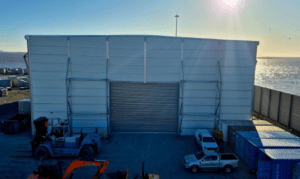
This facility offers a three-year hire period with full reusability, preserving investment value through multiple future applications.
Importantly, aligning with our client’s commitment to producing fully recyclable wind turbine blades, our Evolution structure will be completely dismantled and reused for other projects requiring temporary facilities.
This approach transforms infrastructure from a fixed cost into a flexible asset. The fully sustainable aluminium frame can be adapted for multiple uses, including temporary offices, retail premises, showrooms, sports halls, and specialised storage and warehousing with environmental controls – demonstrating how sustainable construction creates enduring value through adaptability rather than disposal.
7. Quality and Safety
Quality concerns often arise when people first consider modular construction. Can buildings erected quickly really match permanent construction standards?
Absolutely, and our certifications prove it. ISO 9001 ensures quality management, while CHAS and MUTA accreditations demonstrate safety excellence.
Manufacturing in controlled factory environments actually enhances quality consistency compared to weather-dependent on-site construction.
8. User Experience
The ultimate test of any building is the daily user experience. Modern modular buildings provide comfortable, permanent-quality environments with comprehensive heating, cooling, lighting, soundproofing, and natural light integration.
Our Traube Tonbach Temporaire restaurant exemplifies this excellence, offering a panoramic dining space with luxurious interiors that blend seamlessly with permanent facilities.
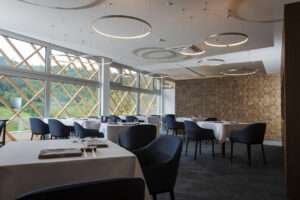
This wasn’t a compromise solution but a sophisticated hospitality environment that enhanced the hotel’s reputation.
9. Reduced Site Impact
Traditional construction transforms sites into industrial zones for months, creating noise, dust, and general disruption that impacts surrounding operations and communities. Modular construction dramatically reduces this impact through off-site manufacturing and rapid on-site assembly.
This proves crucial for schools, retail operations, and urban projects where minimal disruption maintains normal activities.
Faster builds also reduce environmental and community impact, a significant advantage in densely populated areas where construction activity affects many stakeholders.
Industries Transformed by Modular Construction
Modular construction is a flexible approach tailored to specific sector needs. Let’s explore how different industries leverage our solutions to solve unique challenges.
Education
Schools and universities often need additional space quickly, whether for unexpected enrolment growth or during renovation projects. Our modular education buildings provide classrooms, lecture halls, and staff areas that can be installed during term breaks without disrupting learning.
Our modular education building in Delft exemplifies this approach. TU Delft University needed additional lecture capacity for growing student numbers, but wanted flexibility rather than permanent expansion.
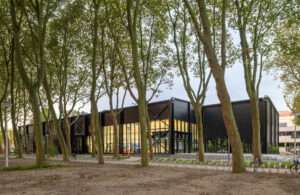
Our Flexolution system delivered a sophisticated 2,115m² facility with four lecture halls and student meeting spaces, complete with optimal acoustics and integrated technology that matches campus standards.
Sports Facilities
Sports halls and facilities require large, clear-span halls with no internal supports, perfect for gymnasiums, indoor pitches, martial arts, and tournaments. Our modular sports halls provide professional environments that serve communities for years.
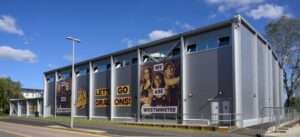
The University of Westminster Sports Hall is a prime example of our modular expertise in the UK. Built using our Flexolution system, this 620m² facility was completed in just a few weeks to provide a modern, high-performance sports environment.
The structure includes a full-sized multi-sport hall, changing rooms, and specialist flooring designed to meet university standards, delivering a premium, energy-efficient facility that seamlessly integrates with the existing campus infrastructure.
Retail & Supermarkets
Retailers can’t afford extended closures during renovation or after emergency damage. Our modular supermarkets and retail structures provide fully functional environments with HVAC systems, lighting, customer facilities, and all amenities customers expect, allowing businesses to maintain operations and relationships.
Our Jan Linders supermarket project perfectly illustrates this capability. After fire destroyed their store on New Year’s Eve, we delivered a complete 1,500m² replacement in just 3 months, including complex engineering to span a canal. Customers couldn’t distinguish the temporary facility from their previous permanent store.
Showrooms
Premium brands require sophisticated presentation environments that reflect their values while offering operational flexibility. Our semi-permanent showrooms provide branded, premium spaces that can be assembled quickly and relocated when needed.
Storage Space
Modern logistics demand flexible storage solutions that adapt to changing inventory levels and seasonal fluctuations.
Our modular storage facilities provide semi-permanent logistics and warehousing hubs with optional climate-controlled zones, specialised shelving, and partition systems.
The Future is Modular Constructions
The evidence is compelling: modular construction delivers superior outcomes across speed, efficiency, flexibility, scalability, cost savings, sustainability, quality, and user experience.
This isn’t about compromise, it’s about choosing the strategically superior approach that enables rather than constrains success.
Modular represents a future-proof solution for modern challenges. In an era where adaptability determines competitive advantage, infrastructure that evolves with your needs provides fundamental business benefits.
Whether facing emergencies requiring rapid response or planning sophisticated long-term facilities, modular construction transforms challenging requirements into successful outcomes.
Neptunus stands as your trusted partner in this transformation. With proven results across education, retail, sports, storage, and hospitality sectors, we combine decades of experience with cutting-edge technology to deliver solutions that consistently exceed expectations.
Build Smarter with Neptunus
Neptunus offers extensive modular construction solutions, including our innovative Evolution and Flexolution systems, plus specialised solutions for education structures, sports halls, supermarkets, showrooms, restaurants, and storage facilities.
Our certifications:
- ISO 9001 for quality
- ISO 14001 for environmental standards
- CHAS and MUTA accreditation for industry-leading safety
Our certifications ensure every project meets the highest professional standards. You’re not just getting buildings; you’re getting permanent-quality infrastructure with modular advantages.
If you need rapid deployment for emergencies or sophisticated long-term facilities, we’ll help you determine the optimal approach for your unique requirements.
Our experienced team understands the challenges facing different industries and can recommend solutions that deliver exceptional outcomes.
Explore Neptunus’s comprehensive product range to discover solutions perfectly matched to your needs. From rapid-deployment systems to sophisticated long-term facilities, we offer modular building solutions that transform challenging requirements into successful projects.
Consult with our experts about your specific project requirements. Our team combines technical expertise with practical experience to recommend approaches that optimise outcomes for your situation and budget.
Call +44 1604 593820 for tailored advice from specialists who understand modular construction’s strategic advantages. If you’re exploring options or ready to proceed with specific requirements, we’re here to guide you through every step.
Contact us today to learn how modular construction can transform your organisation’s approach to infrastructure challenges.