

Are Temporary Buildings a Sustainable and Practical Choice for Businesses
Every business today faces one common challenge: the need for flexible, adaptable space solutions. For a business planning to expand operations, recover from disruption, manage seasonal fluctuations, or launch new projects, the traditional approach of permanent construction may fall short due to meeting urgent timelines and budget constraints.
In such situations, temporary buildings and modular construction solutions can revolutionise how businesses think about space.
With economic uncertainties affecting operational strategies, the demand for sustainable buildings and flexible workspace solutions is only increasing. Companies are leaning towards alternatives that offer both environmental responsibility and operational agility without compromising on quality or functionality.
But can temporary buildings truly deliver sustainability whilst providing the practical solution modern businesses demand?
The answer is yes, but also depends on understanding how these engineered temporary solutions have evolved far beyond basic shelter to become sophisticated, energy-efficient structures that rival permanent structures in performance whilst exceeding them in adaptability.
Why Businesses Are Choosing Temporary Space Solutions
-
Speed to Occupancy
The most compelling advantage of temporary buildings lies in their rapid deployment capability. Where traditional construction projects measure timelines in years, modular buildings can be operational within weeks or months. This speed advantage stems from several factors:
A wide range of our building systems and components are available from stock, enabling us to respond quickly when additional space is required and to commence installation without long lead times.
The reusable building systems approach means modules of structure can be pre-fabricated whilst site preparation occurs simultaneously, significantly reducing overall project timelines.
Our experienced in-house installation teams operate worldwide and know our systems inside out, ensuring buildings are completed and operational in a very short timeframe, with minimal disruption to the surrounding area.
-
Cost-Effectiveness
The financial case for temporary buildings extends well beyond simple acquisition costs. On average, modular projects save 10–25% on design and construction costs compared to traditional methods (Sustainable Party 2024).
Lower upfront capital expenditure (CapEx) makes temporary solutions accessible to businesses with limited initial investment capacity.
Unlike permanent construction requiring substantial upfront commitments, temporary buildings can be hired or purchased as temporary buildings that align costs with operational needs.
Businesses can start with a rental and later buy the structure once its usefulness is proven. The reduced long-term commitment risk will be valuable in uncertain economic climates.
-
Operational Flexibility
Modern businesses operate in environments where space requirements can shift rapidly. Scalable workspace solutions provide the agility that traditional permanent buildings simply cannot match.
These temporary buildings are easy to expand, reduce, or relocate. This allows businesses to respond to market changes, seasonal fluctuations, or project-specific requirements without lengthy planning processes or major capital investments.
If you need more space, additional modules can be bolted on; if you need less, sections can be removed. The modular nature of their warehouses allows businesses to increase or decrease capacity “quickly and easily” without rebuilding.
For example, at Neptunus, we needed to expand operations at our UK headquarters in Northampton, so we turned to our own Flexolution III structure to deliver four state-of-the-art temporary warehouses.
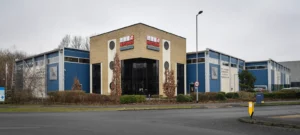
Our objective was to create energy-efficient, scalable storage space quickly, without compromising on performance or sustainability.
We chose an 11,000 m² site at Swan Valley Business Park and designed a future-ready facility centred around a permanent three-storey office building and four semi-permanent Flexolution warehouses. Built in two quick phases, the warehouses were installed in just a few weeks each, while the entire development was completed in under six months.
The Flexolution structures, manufactured and erected by our team, feature modular aluminium frames, laminated wooden trusses, and insulated sandwich panels. This ensures excellent thermal efficiency and year-round climate control. They also achieved a BREEAM ‘Very Good’ sustainability rating and an ‘A’ rated energy performance under the EU Buildings Directive.
Most importantly, these buildings are built to evolve with us. They can be expanded, downsized, or dismantled with ease, demonstrating just how adaptable and future-proof our sustainable temporary buildings truly are.
How Businesses Across Sectors Use Temporary Structures
The versatility of modern temporary buildings extends across virtually every business sector, offering tailored solutions that address specific industry challenges while maintaining the core advantages of flexibility, sustainability, and rapid deployment.
Warehousing & Logistics
Scalable storage solutions that can expand or contract with inventory requirements, seasonal demands, or operational changes are one of the most popular applications for temporary buildings. Businesses experiencing rapid growth can quickly add warehouse capacity without committing to permanent facilities that may become oversized if market conditions change.
For example, a global wind power leader, supplying state-of-the-art 108-metre recyclable turbine blades, required a robust, flexible storage facility at Hull docks to support the Dogger Bank offshore wind farm, set to power 1.2 million UK homes.
Facing space constraints and extreme coastal weather, they turned to Neptunus for a solution. In just three weeks, Neptunus constructed a bespoke 30m × 60m Evolution 1 warehouse with 10.5m internal clearance, reinforced bracing, and a 10m-wide roller shutter door to accommodate giant components.
The fully dismantlable structure aligned with the client’s sustainability goals and will be repurposed after the 3-year hire period.
Manufacturing
Production facilities that can be rapidly deployed for new product lines, temporary capacity increases, or emergency manufacturing needs provide manufacturers with unprecedented operational flexibility. Automotive suppliers can establish temporary assembly lines to meet sudden demand spikes or support new vehicle launches without permanent facility investments.
Emergency manufacturing scenarios, such as responding to supply chain disruptions or natural disasters, benefit enormously from the rapid deployment capabilities of temporary facilities.
For instance, Whirlpool UK Appliances Limited needed a robust, modern showroom at their Peterborough headquarters to display their full range of white goods to distributors. The previous temporary facility had suffered from noise and instability in windy conditions, so a more solid, semi-permanent structure was essential. The solution also had to be delivered quickly without disrupting ongoing business operations.
Neptunus installed a 1,000 m² Evolution II temporary building with 6-metre leg height, insulated roof and walls, and a glazed frontage. Erected in just one week, with an additional three weeks for fit-out, the structure offered exceptional durability, comfort, and aesthetics, closely resembling a permanent building.
Originally hired for 12 months, Whirlpool extended the contract to four years, making the space a long-term showcase for their evolving product lines.
Supermarkets & Retail Spaces
Temporary buildings offer retailers the flexibility to respond quickly to market changes without the burden of long-term lease commitments. These customer-facing spaces are designed to match the aesthetics of permanent structures, allowing brands to test new markets, launch pop-up stores, or establish seasonal retail presences with ease. For supermarkets, fashion outlets, and home improvement brands, these structures can be deployed in high-footfall areas to boost visibility and capture consumer interest.
In Stein, Netherlands, a devastating fire destroyed a shopping centre, forcing 30 retailers, including Aldi, to shut down indefinitely. With damages estimated at €32 million, mall owners urgently needed a long-term temporary solution to prevent customer loss and minimise revenue disruption.
Neptunus was commissioned to build a high-quality interim retail facility. In just four months, the team constructed a 9,000 m² temporary mall, Europe’s largest, using seamlessly connected Evolution structures. Each store was custom-fitted, and the centre featured a weatherproof central walkway, lighting, climate control, and security.
Designed to operate for at least three years, the temporary mall allowed retailers to resume operations quickly, retain their customer base, and continue trading while the permanent site was rebuilt.
Automotive & Furniture Showrooms
Automotive dealerships often turn to temporary buildings for vehicle launches, customer events, or when their main showroom is undergoing renovation. These structures can seamlessly incorporate vehicle display areas, customer reception zones, and service facilities while maintaining a high standard of presentation and brand consistency. Similarly, furniture and home retailers can benefit from short-term showroom setups in prime locations, ideal for showcasing seasonal ranges or trialling new locations without the risks of permanent investment.
There was a similar situation when HR Owen, the UK’s leading luxury automotive retail group, needed a high-spec temporary showroom for its Bentley and Lamborghini brands during the construction of a new sales centre in Hertfordshire. Neptunus provided a 450 m² Flexolution II showroom in just eight days. The structure featured oversized doors for vehicle access, large display windows, reinforced flooring for tiled finishes, and fully branded customer areas including offices, toilets, and a kitchen.
Originally planned for 18 months, the facility remained in use for over three years due to pandemic delays. Despite being temporary, it delivered a luxury customer experience aligned with the prestige of both brands, proving how adaptable and premium temporary showrooms can be.
Exhibitions
Sophisticated spaces that can be customised for specific events whilst providing the infrastructure for complex requirements, serve the dynamic events industry, where requirements change dramatically between applications.
Trade shows and exhibitions require flexible spaces that can be rapidly reconfigured between events, with temporary buildings providing controlled environments for valuable displays and equipment whilst accommodating large visitor numbers safely and comfortably.
For Europe’s largest home and interior fashion fair, Maison & Objet, Neptunus was commissioned by Reed Exhibitions to construct a temporary expo space that would match permanent standards. Held in Villepinte, Paris, the show attracted 69,000 industry professionals, requiring over 15,000 m² of high-quality, weather-resistant exhibition halls.
Neptunus installed interlinked Evolution structures within three weeks, delivering open-plan, column-free spaces with integrated infrastructure, including a temporary restaurant and visitor entrances. These halls offered a professional look and feel while meeting stringent requirements for comfort, safety, and adaptability.
The result was a seamless visitor experience and a high-performance temporary venue that showcased the flexibility, speed, and quality of Neptunus’ Evolution technology on an international stage.
What Makes Temporary Buildings a Sustainable Option?
-
Material Efficiency
The sustainability credentials of sustainable temporary buildings are rooted in fundamental design principles that prioritise resource efficiency and reusability. Unlike traditional construction, which typically involves single-use materials and demolition waste, eco-friendly modular buildings are engineered for multiple lifecycle applications.
High-quality, durable materials, including aluminium frames, steel components, and engineered panels, are selected specifically for longevity and repeated use. These materials can withstand multiple assembly and disassembly cycles whilst maintaining structural integrity and aesthetic appeal.
-
Reduced Construction Waste
Factory-controlled manufacturing eliminates many waste sources inherent in traditional construction. Components are manufactured to precise specifications in controlled environments, minimising off-cuts, errors, and material waste.
Pre-frabricated components reduce site waste further by ensuring components fit together precisely without modification. This precision manufacturing approach contrasts sharply with traditional construction, where significant material waste occurs through cutting, fitting, and error correction.
-
Energy Efficiency
Modern energy-efficient temporary buildings challenge misconceptions about structural performance. Advanced sustainable temporary buildings incorporate sophisticated insulation systems, efficient building envelopes, and high-performance components that can exceed permanent building standards.
-
End-of-Life Management
The circular economy advantages of temporary buildings extend beyond initial use to encompass sophisticated end-of-life management strategies that maximise material value and minimise waste.
Instead of requiring demolition that generates substantial waste streams, temporary buildings can be systematically disassembled with materials flowing directly into reuse or recycling applications.
When do Temporary Buildings Excel?
Temporary buildings are especially advantageous in several specific scenarios, providing significant benefits over traditional construction approaches. Here’s when temporary buildings excel:
- Short-to-medium term needs (1- 10+ years) represent the sweet spot for temporary buildings. These timeframes allow businesses to capture the cost and flexibility advantages whilst amortising acquisition costs effectively.
- Rapid deployment requirements make temporary buildings the obvious choice when speed to occupancy is critical. For responding to emergencies, market opportunities, or operational disruptions, the ability to become operational quickly provides significant competitive advantages.
- Uncertain future space needs favour temporary buildings because they provide options rather than commitments. As business requirements evolve, structures can be modified, relocated, or repurposed rather than abandoned.
- Remote or challenging sites often favour temporary buildings because they can be transported and assembled in locations where traditional construction would be impractical or prohibitively expensive.
Transform Your Business Space with Sustainable Temporary Buildings
For businesses seeking sustainable buildings, flexible workspace solutions, or cost-effective temporary buildings, it is evident that modern temporary buildings represent not just a practical alternative to permanent construction but often a superior solution that delivers enhanced value, reduced environmental impact, and operational agility that permanent structures simply cannot match.
The future of business infrastructure lies in solutions that combine operational excellence with environmental responsibility. Neptunus sustainable temporary buildings provide the perfect platform for businesses ready to embrace this future whilst delivering immediate practical advantages.
Our expert team is ready to help you discover how Neptunus structures can transform your operational capabilities whilst supporting your sustainability goals.
Why Partner with Neptunus?
- Engineering Excellence: With almost 90 years of experience pioneering reusable building systems, leading manufacturers have developed frame technology capable of extended lifecycle uses, representing genuine circular economy construction principles in action.
- Certified Standards
- ISO 9001:2015 Certification for quality management and customer focus
- ISO 14001:2015 Certification for environmental responsibility
- CHAS (Contractors Health & Safety Assessment Scheme) to ensure professional standards and reliable performance.
- Fast Delivery & Full Compliance: Our buildings are quick to install and fully compliant with UK building and safety standards.
- Flexible Ownership Options: If you’re not ready to commit to ownership, then you can hire a building for weeks, months, or years, perfect for testing new markets or managing temporary demand. If you prefer a long-term solution, we offer purchase options, too, allowing you to choose the approach that best fits your business needs and financial strategy.
If you’re planning an urgent expansion, managing a complex project, or seeking flexible solutions for evolving business requirements, we have the experience, expertise, and innovative products to deliver exceptional results.
Neptunus offers a comprehensive range of temporary building solutions and event structures that support business growth, operational efficiency, and long-term environmental responsibility.
Call us today at +44 1604 593820 to discuss how Neptunus structures can help your business achieve its goals through innovative, sustainable, and flexible building solutions. Or fill out our online enquiry form, and our experts will reach out to you with detailed information about how Neptunus can support your business objectives.